
Why an HVAC Technician Course is Your Fast Track to a Stable Career
An hvac technician course prepares you to maintain and repair heating, ventilation, air conditioning, and refrigeration systems in residential, commercial, and industrial settings. NTI’s accelerated programs are only 10-16 weeks and combines classroom instruction with hands-on lab training, covering core skills like refrigeration theory, electrical circuits, system troubleshooting, and safety certifications such as EPA Section 608.
Quick Overview: What You’ll Get from NTI’s HVAC Technician Course
| Duration | 12 weeks (accelerated program) |
| Learning Format | In-person, hybrid, or online with hands-on labs |
| Core Skills | Refrigeration, electrical work, heating systems, troubleshooting |
| Certifications | EPA 608 |
| Career Outcomes | Entry-level HVAC technician, installation tech, refrigeration mechanic |
| Salary Potential | Average $59,810/year nationally (https://www.bls.gov/ooh/installation-maintenance-and-repair/heating-air-conditioning-and-refrigeration-mechanics-and-installers.htm) |
If you’re looking for a career that offers job security, hands-on problem-solving, and real earning potential without spending four years in college, HVAC training is one of the smartest moves you can make. The industry is growing fast—over 40,000 job openings are projected annually through 2034, according to the U.S. Bureau of Labor Statistics. That demand means employers are actively hiring skilled technicians, and many are willing to train motivated beginners.
HVAC systems have become increasingly complex, combining mechanical, electrical, and digital controls. This complexity means employers now prefer candidates with formal post-secondary training rather than just on-the-job experience. A quality hvac technician course gives you the foundational knowledge and hands-on practice you need to stand out in the job market and start earning quickly.
Why choose NTI’s accelerated training? Traditional programs can stretch over two years, but our accelerated courses condense the same essential skills into 10-16 weeks. You’ll learn to use safe work practices, operate industry-standard tools and equipment, apply refrigeration fundamentals, understand electrical concepts, and plan and install HVAC systems—all while building real projects in a shop environment.
What about cost? NTI’s vocational HVAC program is significantly more affordable than a four-year college degree. Many students qualify for financial aid through grants, scholarships, or veteran benefits to help cover costs. When you factor in the shorter time to graduation and faster entry into paid work, the return on investment is compelling.
You’ll also find flexible learning options designed for working adults. NTI’s hybrid programs blend online coursework with in-person lab sessions, letting you study classroom work at home while still coming to the campus to get the hands-on lab experience employers demand. Evening and weekend classes, block-based scheduling, and multiple start dates make it easier to fit training around your current responsibilities.
I’m Ryan Woodward, and as CEO of National Technical Institute and as an active member of workforce development agencies, I’ve seen how an hvac technician course can transform lives by opening doors to stable, well-paying careers in the skilled trades. At NTI, we focus on accelerated curricula, hands-on training, and flexible learning options at campuses in Las Vegas, Phoenix, and Houston to help students like you launch successful careers fast.
What to Expect from an HVAC Technician Course
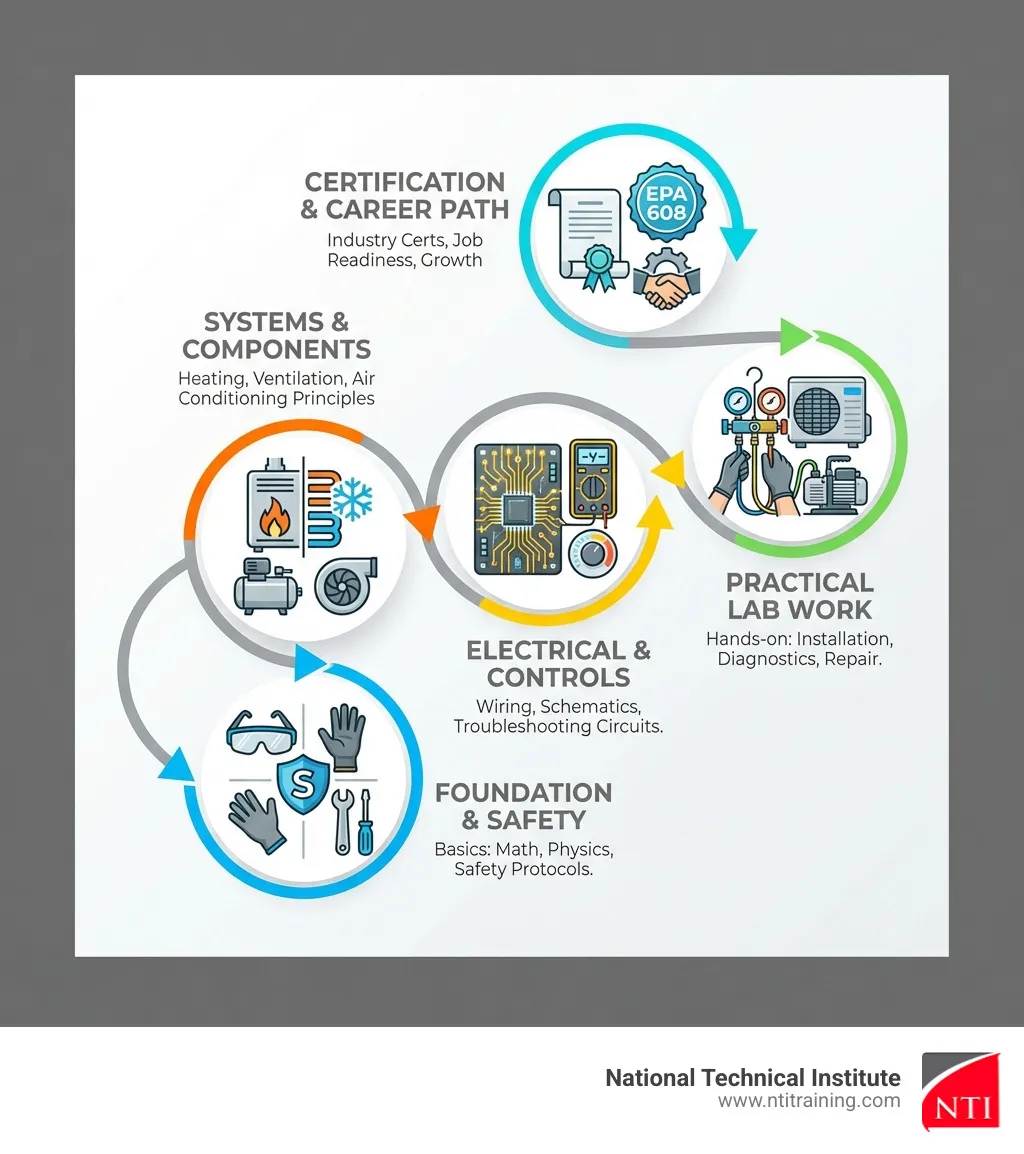
When we talk about an hvac technician course, we aren’t just talking about reading books. Modern vocational education is designed to be immersive. At National Technical Institute (NTI), we’ve built our programs to mirror the real world. You can expect a mix of theoretical “why” and practical “how.”
Program Duration and Delivery
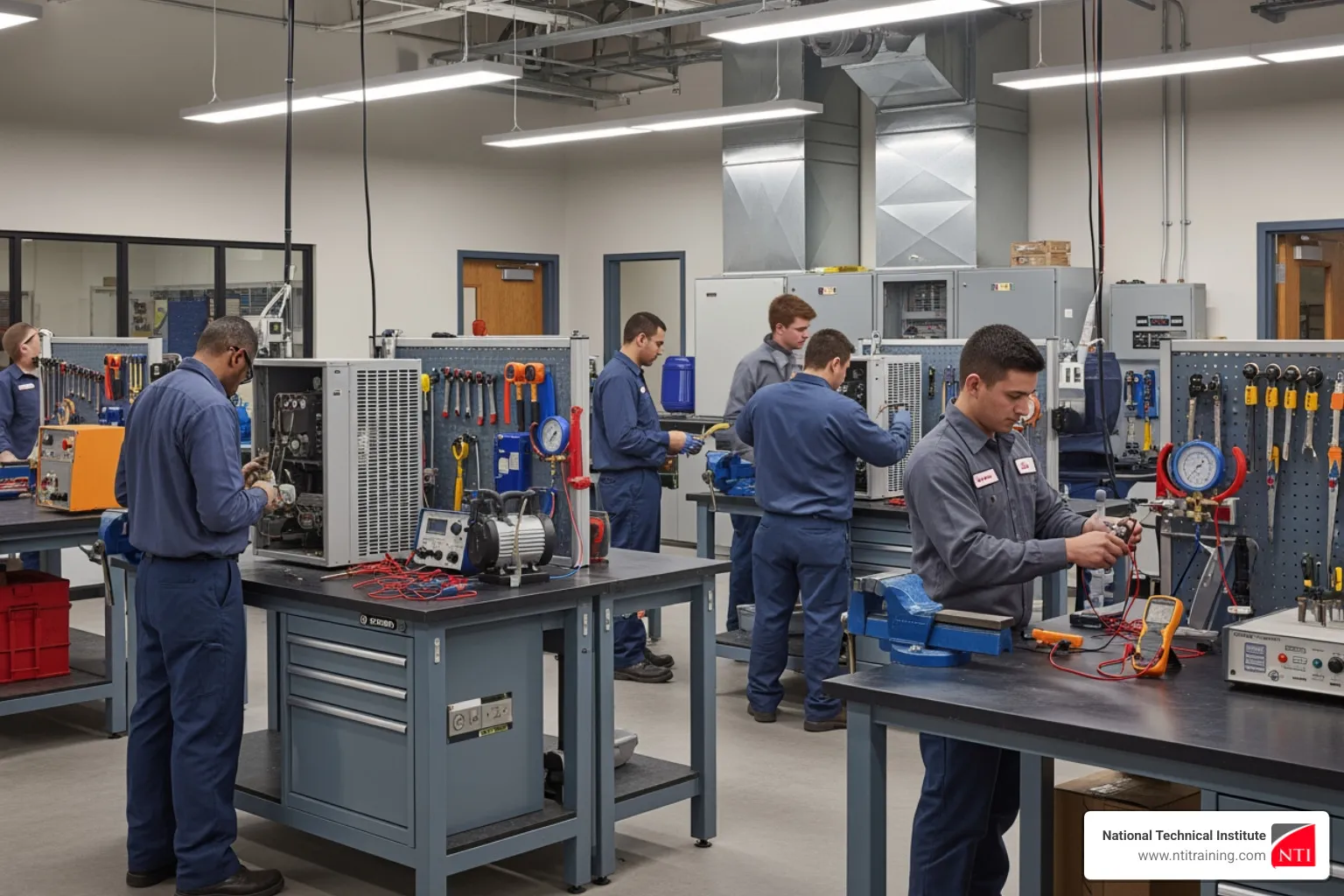
Most traditional community college programs take two years to complete. However, we know that our students want to get into the workforce faster. Our accelerated programs can get you career-ready in 10-16 weeks. We offer several ways to learn:
- In-Person Training: Traditional classroom and shop instruction at our campuses in Las Vegas, Phoenix, and Houston.
- Hybrid Learning: This is a popular choice for busy students. You handle your lectures and theory online and come to the campus for intensive, hands-on lab sessions. There are many benefits of hybrid learning in HVAC training, including the ability to keep your current job while you train.
- Full-time vs. Part-time: We offer morning, afternoon, and evening blocks to fit your schedule.
Tuition and Value
One of the biggest hurdles to education is cost. We pride ourselves on offering tuition that is much more affordable than a typical 4-year college degree. Because our programs are shorter, you also save on the “opportunity cost” of being out of the workforce for years.
| Format | Delivery Method | Best For |
|---|---|---|
| In-Person | 100% Campus-based | Students who prefer face-to-face instruction |
| Hybrid | Online Theory + Campus Labs | Working adults needing flexibility |
Entrance Requirements and Prerequisites
You don’t need to be a rocket scientist to start an hvac technician course, but you do need a solid foundation.
- High School Diploma or Equivalent: This is the standard requirement for most vocational programs. Don’t have one? We offer the opportunity to pass a federally approved ATB (Ability-To-Benefit) test to meet this requirement.
- Mechanical Reasoning: Do you like taking things apart to see how they work? That curiosity is a great indicator of success.
- Physical Fitness: HVAC work involves climbing ladders, lifting equipment, and working in tight spaces (like attics or crawl spaces).
- Math Skills: You’ll need basic math for measurements, electrical calculations, and load formulas.
- Admissions Process: Learning how to apply for NTI trade programs is simple. Our admissions team walks you through the paperwork, helps you explore financial aid, and ensures you’re a good fit for the trade.
Typical Program Length and Delivery Options
We understand that life doesn’t stop just because you want to go back to school. That’s why we offer flexible start dates throughout the year. Instead of waiting for a “fall semester,” you can often start within weeks. Our block-based scheduling means you know exactly when you’ll be in class, making it easier to arrange childcare or work shifts.
Core Competencies and Skills Taught in HVAC Programs
What exactly will you be doing in the lab? An hvac technician course covers a broad spectrum of mechanical and electrical systems.
Core Subjects in a Beginner HVAC Technician Course
- Refrigeration Theory: Understanding how heat moves and how refrigerants change states to cool a room.
- Electrical Circuits: You’ll learn to read schematics, wire thermostats, and troubleshoot motors and capacitors.
- Troubleshooting: This is the heart of the job. You’ll learn how to diagnose why a system isn’t cooling or heating and the fundamentals of how to fix it efficiently.
- Heating Fundamentals: Working with gas furnaces and heat pumps.
- Piping and Brazing: Learning how to cut and join copper tubing using high-temperature torches.
- Ductwork Design: Ensuring that the air actually reaches the rooms it’s supposed to.
To stay ahead of the curve, we often recommend top HVAC books to read to supplement your hands-on training. We also provide plenty of tips for new HVAC technicians to help you navigate your first few months on the job.
Soft Skills and Customer Service Training
Being a great technician isn’t just about fixing machines; it’s about helping people. Customer service in HVAC is critical. You are often entering a customer’s home when they are stressed because their AC is out in 100-degree weather.
We share with you how to:
- Communicate technical problems in simple terms.
- Maintain professional ethics and appearance.
- Help customers save money by explaining how to save on HVAC through maintenance and energy-efficient upgrades.
Essential Certifications for New HVAC Technicians
In the HVAC world, certifications are your “license to earn.” They prove to employers and the government that you know how to work safely and legally.
EPA Section 608 Certification
This is the big one. Under Section 608 of the Clean Air Act, anyone who maintains, services, or repairs equipment that could release refrigerants into the atmosphere must be certified. Our hvac technician course includes intensive EPA 608 certification details and preparation. We cover:
- Core: General environmental knowledge.
- Type I: Small appliances.
- Type II: High-pressure systems (residential AC and commercial heat pumps).
- Type III: Low-pressure systems (large chillers).
- Universal: Covers all of the above.
Preparing for Certification
We don’t just hand you a book and hope for the best. Our training includes practice simulations and a comprehensive HVAC technician training guide to assist you in passing your exams on the first try. We often include exam vouchers in the cost of the program, so there are no surprise fees at the end.
Career Advancement
Our programs are designed to give you a “head start,” providing the technical training levels that many employers look for when hiring new technicians. Through our career services support, we help connect you with local companies in Las Vegas, Phoenix, and Houston that are ready to hire.
Job Market Demand and Employment Outlook
The demand for technicians is skyrocketing. This is due to a combination of an aging workforce retiring and the massive growth in new construction in cities like Phoenix and Houston. Employers are looking for specific qualities in HVAC recruits, such as reliability, a clean driving record, and a solid technical foundation from a reputable school.
You can find work in:
- Residential Service: Fixing AC units and furnaces in homes.
- Commercial Refrigeration: Maintaining the cooling systems in supermarkets and restaurants.
- Facility Maintenance: Working for hospitals, schools, or large office complexes.
- Green Technology: Installing energy-efficient green HVAC systems and smart building automation.
Salary Overview
While entry-level pay varies, the HVAC technician salary overview is very promising. As stated above, nationally the average is around $60,000 per year, but experienced technicians—especially those in specialized commercial or industrial roles—can earn significantly more. In high-demand areas like Las Vegas, Phoenix, and Houston there are always top HVAC companies hiring that offer competitive wages and benefits.
Frequently Asked Questions about HVAC Training
How long does it take to become an HVAC technician?
At NTI, our accelerated programs can take as little as 3 to 4 months. Traditional associate degrees at community colleges typically take 2 years. If you pursue a full journeyman status through an apprenticeship, that can take 4 to 5 years of on-the-job training combined with school.
Can I take an HVAC course online?
You can learn the theory online, which is why we offer hybrid models. However, you cannot become a competent technician without touching the equipment. NTI’s hybrid model gives you the benefits of hybrid learning by letting you do the bookwork at home, but we require you to come into our state-of-the-art labs for hands-on practice.
What is the average cost of an HVAC technician course?
While we don’t list specific tuition here because it can change, NTI is committed to being much more affordable than a 4-year university. We also help students explore financial aid options to make sure money isn’t the thing standing between you and your new career.
Launch Your HVAC Career with NTI Today
Starting your first hvac technician course is the first step toward a career that offers independence, high earning potential, and the satisfaction of solving real-world problems. At National Technical Institute, we’ve stripped away the fluff of traditional college to give you exactly what you need to succeed: accelerated curricula, hands-on training, and career services support.
Whether you are in Nevada, Texas, or Arizona, we have the facilities and the expertise to help you launch. Don’t spend years in a classroom when you could be out in the field earning a great living in just a few months.
Ready to change your life? Start your career at NTI today and join the thousands of graduates who have found success in the skilled trades.
Share This Story
Get Started with NTI
We are here to answer your questions about NTI and the path for your career as an HVAC technician, electrician, or plumber. Our team is dedicated to helping you make an informed decision about your future. Whether you’re just starting to explore your options or you’re ready to take the next step, we can help. Connect with us today to learn more and get started on the application process.