
Is Hands-On Trade Training the Fastest Path to a Skilled Career?
Hands-on learning is one of the most direct routes into a well-paying, in-demand career — without a four-year degree or mountains of student debt.
Here’s a quick look at what that path involves:
- What it is: Learning by doing — using real tools and equipment to build job-ready skills
- Who it’s for: Anyone ready to enter trades like HVAC, plumbing, or electrical work fast
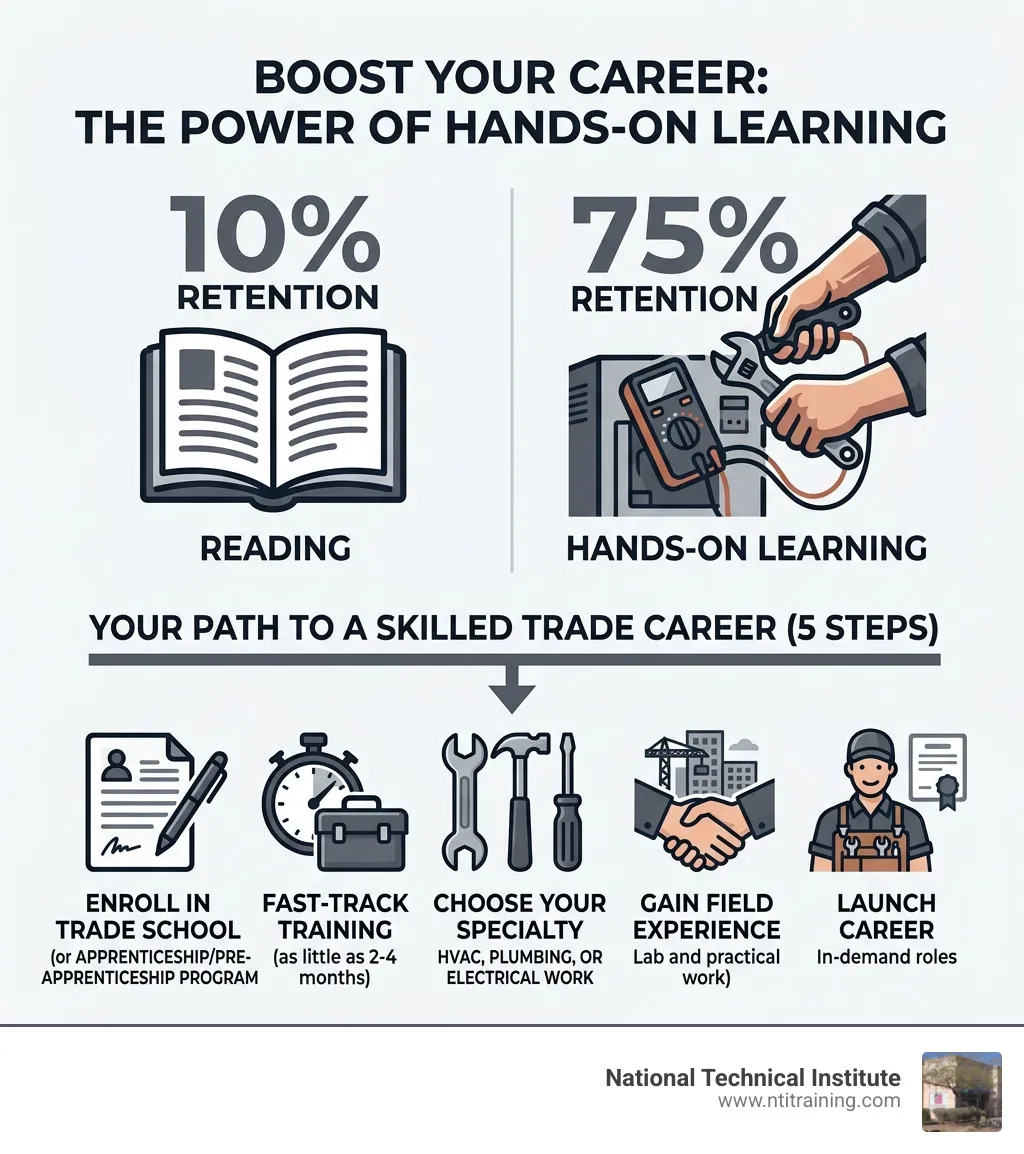
- How long it takes: As little as 2 to 4 months with an accelerated program like NTI’s
- What you’ll earn: Construction and trades jobs average strong salaries, with HVAC, electrical, and plumbing roles in high demand nationwide
- Where to start: Enroll in a hands-on trade school, apprenticeship, or pre-apprenticeship program
Think about the last time you tried to learn something just by reading about it. Maybe it stuck for a day. Maybe less. Now think about the first time you actually did something with your hands — fixed a leaky faucet, wired a light switch, changed an engine part. That kind of learning tends to stick.
There’s science behind that feeling. Research from the National Training Laboratories shows we retain up to 75% of what we actively do, compared to just 10% of what we read. For trade careers — where a wrong wire or a bad pipe joint can cause real damage — that difference isn’t just academic. It’s everything.
The skilled trades are also facing a serious worker shortage right now. According to the U.S. Bureau of Labor Statistics, HVAC jobs alone are expected to grow 9% by 2033, much faster than the average for all occupations. For every five skilled workers retiring, only about two new workers are entering the field. That gap means real opportunity for people willing to train.
I’m Ryan Woodward, CEO of National Technical Institute (NTI), and I’ve served on Nevada’s Governor’s Workforce Development Board as well as currently chair the Vegas Chamber’s Workforce Development Committee, where I help shape hands-on learning trades education across the state. In this guide, I’ll walk you through exactly how practical trade training works, why it outperforms traditional classroom learning, and how NTI’s programs can get you career-ready faster than you might think.
Why Hands-On Learning Trades Training is Essential
If you have ever tried to assemble furniture using only a tiny, confusing manual, you know the frustration of “book learning.” In skilled trades, that frustration can turn into a safety hazard. That is why hands-on learning trades training is not just a “nice to have”—it is the backbone of the entire industry.
When you train in a lab, you aren’t just memorizing facts for a test. You are building muscle memory. Whether you are welding a joint or troubleshooting a circuit board, your hands learn the “feel” of the work. This makes you ready for the real world on day one. At National Technical Institute, we focus on this exact style of training because we know that employers value problem-solving skills over high test scores.

The Difference Between Doing and Reading
Traditional classrooms often focus on “auditory” or “visual” learning—basically, listening to a lecture or looking at a PowerPoint. But many of us are kinesthetic learners. This means we learn best by moving and doing.
When you engage in Skills in Electrical Technician Training, you aren’t just reading about the National Electrical Code. You are physically pulling wire and installing breakers. This approach fosters creativity and forces you to solve problems in real-time. If a circuit doesn’t live up to its promise, you have to figure out why. That is a skill a textbook simply cannot teach.
Building Confidence Through Practice
Let’s be honest: the first time you use a powerful tool or work with high-voltage electricity, it can be a little scary. Hands-on learning trades programs allow you to make mistakes in a safe, controlled environment.
We believe in the power of trial-and-error. In our labs, you can practice until you get it right. This builds a level of confidence that you just can’t get from a video. By the time you reach a real job site in Houston, Las Vegas, or Phoenix, you already know the safety protocols and tool mastery required to do the job right. You can see more about our approach at NTI: Hands-On Career Training.
The Benefits of Practical Training Over Traditional Classrooms
Many people are told that a four-year college degree is the only path to success. But for many, that path leads to a mountain of debt and a job that doesn’t even require a degree. Trade school offers a different way.
| Feature | Traditional 4-Year College | NTI Trade School |
|---|---|---|
| Time to Completion | 4+ Years | 2 to 4 Months |
| Cost | High (often $100k+) | Affordable (Cheaper than a degree) |
| Learning Style | Theory & Lectures | Hands-On & Practical |
| Job Readiness | General Knowledge | Specific Career Skills |
Faster Entry into the Workforce
Time is money. Every year you spend in a classroom is a year you aren’t earning a paycheck. NTI’s accelerated programs are designed to get you out of the classroom and into the field in just a few months.
Whether you are starting an Electrical Technician program or diving into HVAC, our 2-4 month timelines are built for speed without cutting corners. We focus on exactly what you need to know to get hired. Plus, we offer direct job placement assistance to help you bridge the gap between graduation and your first day on the job.
Higher Retention and Skill Mastery
Because we use multi-sensory learning, our students tend to remember what they learn much longer than traditional students. We use industry-standard equipment that you will actually see in the field. This means there is no “culture shock” when you walk onto your first job site. You’ve already seen the machines, used the tools, and solved the common problems. Check out our Hands-On Learning at NTI page to see the specific equipment we use in our labs.
High-Demand Careers and Earning Potential in 2026
The year 2026 is an incredible time to be in the trades. We are currently seeing a massive “retirement gap.” As the older generation of plumbers, electricians, and HVAC techs retires, there aren’t enough new workers to take their place. This puts you in the driver’s seat.
Why Trades are “AI-Proof”
You’ve probably heard a lot about AI taking over jobs. While AI is great at writing emails or analyzing data, it cannot crawl into a crawlspace to fix a burst pipe. It cannot climb a ladder to repair a rooftop AC unit in the 110-degree heat.
Physical labor combined with complex troubleshooting requires human expertise and “feeling.” This makes hands-on learning trades some of the most secure career paths available today. As long as people have homes and businesses, they will need skilled technicians. You can read more about The Value of Hands-On Learning and why these skills are timeless.
Mastering Skills with NTI’s Hands-On Learning Programs
We believe NTI’s HVAC training program is superior because we don’t just teach the basics; we teach the specific skills employers are begging for. Our curriculum includes:
- Refrigeration Fundamentals
- Electrical 1 & 2
- Advanced AC
- Heat Pumps
- EPA Certification (EPA 608)
- Gas Heating
- Sealed System Repairs
- Brazing
- Rooftop Units
- Installation Basics
By focusing on these areas, we ensure our graduates are ready for residential and commercial work. We also prioritize the EPA 608 certification, which is legally required for anyone handling refrigerants. You can learn more at HVAC Technician Training – Everything You Need to Know.
NTI’s Hands-On Learning Trades Electrical and Plumbing Paths
If electricity or plumbing is more your style, we have world-class programs for those too.
NTI’s Electrical program covers:
- Career in Electrical
- Electrical Codes and Laws
- Electrical Tools
- Electrical Procedures
- National Electrical Code
- Electrical Applications
- Residential / Commercial
- Commercial Electrical Applications
NTI’s Plumbing program covers:
- Principles of Plumbing
- Health and Safety
- Plumbing Math and Formulas
- Toilet Function and Repair
- Fixture Install and Repair
- Pipe Joining
- Gas Piping
- Water Heaters / Drain Equipment / Trenching
Whether you choose our Las Vegas Electrical Technician Training Program or our Houston Plumbing Training Program, you are getting a curriculum designed by industry experts to get you working fast.
How to Start Your Hands-On Trade Education
Starting a new career can feel overwhelming, but we make the enrollment process as simple as possible. We offer flexible learning modalities, including online theory classes combined with in-person lab work at our campuses in Nevada, Texas, and Arizona.
Requirements and Accessibility
We want to make sure the trades are accessible to everyone. To enroll, you generally need a high school diploma or a GED. However, we know that life happens. We offer the chance to take an ATB (Ability-To-Benefit) test as an equivalent to a high school diploma or GED. This ensures that if you have the drive and the talent, you have a place at NTI. You can find more details on our Plumbing Full Course page regarding enrollment.
Finding Grants and Apprenticeships
While NTI is much more affordable than a 4-year degree, we still want to help you find ways to fund your education. We accept Veteran’s benefits for those who have served. Additionally, there are many external resources like Apprenticeship.gov and Explore The Trades that can help you find grants or on-the-job training opportunities. Programs like the Explore The Trades Skills Lab are great examples of how the industry is investing in the next generation of workers.
Frequently Asked Questions about Hands-On Learning Trades
How long does it take to complete a trade program?
At NTI, we value your time. Our accelerated training programs can be completed in as little as 2 to 4 months. This is significantly faster than traditional community colleges or vocational schools that may take two years. For a deeper look at the timeline, see our HVAC Technician Course Complete Guide.
Is trade school cheaper than a four-year college?
Yes! NTI offers affordable tuition that is much cheaper than a typical 4-year degree. We focus on keeping costs low so you can start your career without being weighed down by massive student loans. We encourage you to talk with one of our enrollment officers for specific tuition questions and to find out about payment plans. You can start by looking at our Phoenix Electrical Technician Training Program.
Can I get a job immediately after training?
While no school can “guarantee” a job, NTI provides robust career services and direct job placement assistance. We have strong partnerships with local employers in Houston, Las Vegas, and Phoenix who specifically look to hire NTI graduates because they know our students have the hands-on learning trades experience they need. Check out our Las Vegas HVAC Technician Training Program for more on our placement success.
Start Your Career Journey with National Technical Institute
If you are ready to stop sitting behind a desk and start building a real future, hands-on learning trades is the way to go. National Technical Institute is the preferred choice for trade education because we combine accelerated curricula with the practical, real-world training that employers actually want.
With multiple locations, affordable tuition, and a focus on getting you hired, we are here to help you every step of the way. Don’t spend another four years waiting for your life to start. Visit https://www.ntitraining.com/ today and let’s get to work!
Share This Story
Get Started with NTI
We are here to answer your questions about NTI and the path for your career as an HVAC technician, electrician, or plumber. Our team is dedicated to helping you make an informed decision about your future. Whether you’re just starting to explore your options or you’re ready to take the next step, we can help. Connect with us today to learn more and get started on the application process.